Lipid
Science: Understanding Fats, Oils, and Their Role in Life
Introduction
Lipid science is the branch of biology and chemistry that
studies lipids—a broad group of naturally occurring molecules
that include fats, oils, waxes, phospholipids, and sterols. Though often
misunderstood or oversimplified as “just fats,” lipids are essential to
life, playing critical roles in energy storage, cell structure,
hormone production, brain function, and nutrition.
From cooking oils and dairy fats to cell membranes and
human metabolism, lipid science connects food, health, agriculture, and
biochemistry in powerful ways.
What Are Lipids?
Lipids are organic compounds that are insoluble in
water but soluble in non-polar solvents like ether or
chloroform. Their water-repelling (hydrophobic) nature is what gives lipids
many of their unique biological functions.
Major Types of Lipids
1.
Triglycerides (Fats & Oils)
o Main
form of dietary fat
o Composed
of glycerol + three fatty acids
o Solid
at room temperature = fats (e.g., butter)
o Liquid
at room temperature = oils (e.g., coconut, groundnut, sesame oil)
2.
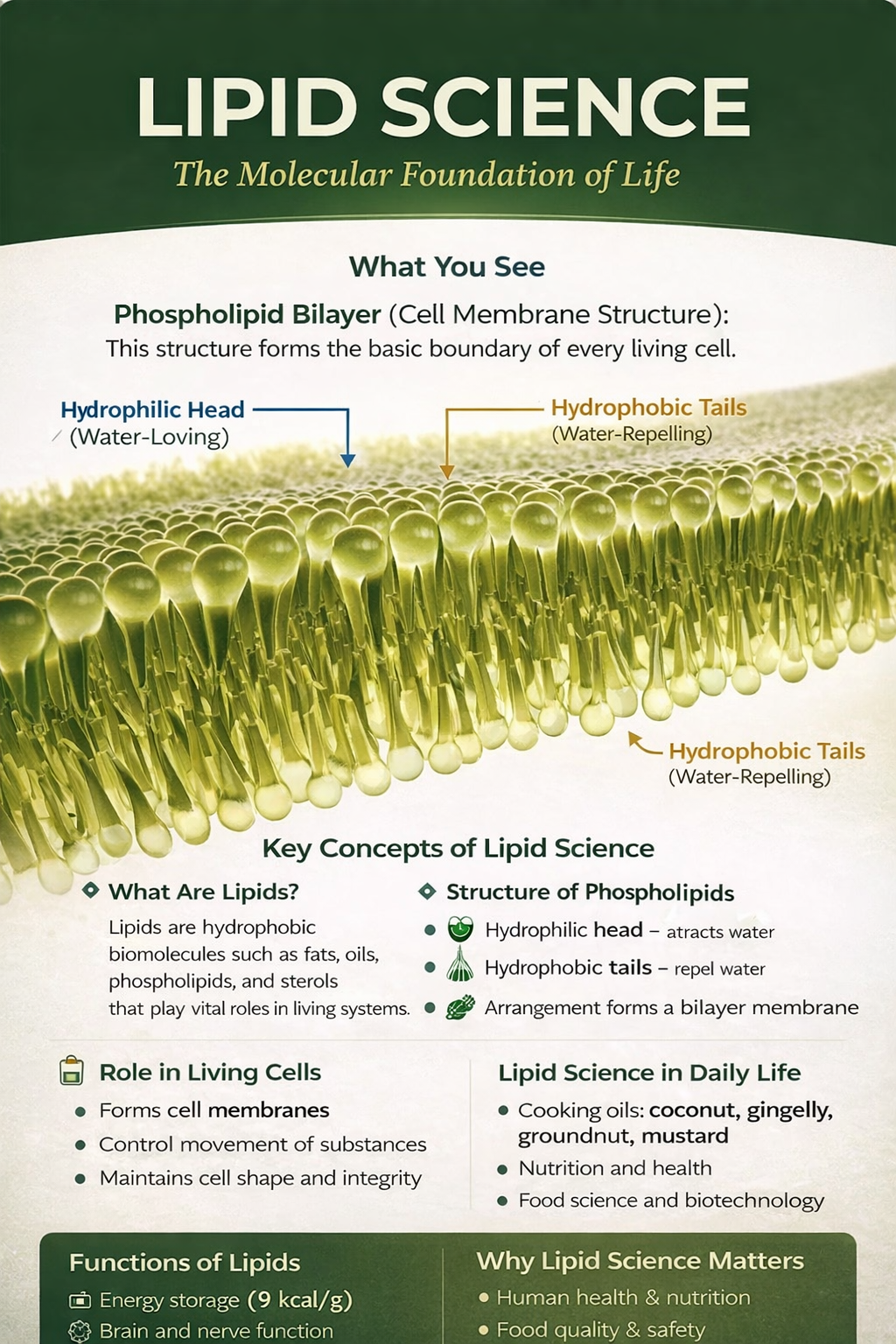
Phospholipids
o Key
components of cell membranes
o Have
both hydrophilic (water-loving) and hydrophobic parts
o Enable
cells to form protective barriers
3.
Sterols (e.g., cholesterol)
o Important
for hormone synthesis
o Structural
component of cell membranes
o Often
misunderstood but vital in correct amounts
4.
Waxes
o Protective
coatings in plants and animals
o Found
on leaves, fruits, and skin
Fatty Acids: The Building Blocks
Fatty acids determine the behavior,
stability, and health effects of lipids.
Types of Fatty Acids
· Saturated
Fatty Acids
o No
double bonds
o More
stable, heat-resistant
o Found
in coconut oil, ghee, butter
· Monounsaturated
Fatty Acids (MUFA)
o One
double bond
o Heart-friendly
o Found
in groundnut oil, olive oil
· Polyunsaturated
Fatty Acids (PUFA)
o Multiple
double bonds
o Includes
omega-3 and omega-6
o Sensitive
to heat and oxidation
· Trans
Fatty Acids
o Artificially
modified
o Harmful
to health
o Now
restricted or banned in many countries
Lipids in Human Health
Lipid science plays a major role in nutrition and
medicine.
Key Health Functions
·
·
·
·
·
Balance Is Key
Not all fats are bad. Health outcomes depend on:
· Type
of fat
· Processing
method
· Cooking
temperature
· Overall
dietary pattern
Lipid Oxidation and Stability
One of the most important topics in lipid science is oxidation.
· Unsaturated
fats oxidize faster
· Heat,
light, and oxygen accelerate degradation
· Oxidation
leads to:
o Rancidity
o Loss
of nutrients
o Formation
of harmful compounds
Cold-pressed and traditionally
processed oils often retain natural
antioxidants that improve stability.
Lipids in Food Science
In food technology, lipids influence:
· Flavor
and aroma
· Texture
and mouthfeel
· Shelf
life
· Frying
performance
Examples
· Saturated
fats → better for deep frying
· Unsaturated
oils → better for low-heat cooking or raw use
· Emulsions
(like mayonnaise) depend on phospholipids
Lipid Science and Traditional
Knowledge
Modern lipid science increasingly validates traditional
food practices, such as:
· Using
coconut oil or ghee for high-heat cooking
· Roasting
seeds before oil extraction
· Storing
oils in dark, airtight containers
These methods reduce oxidation and preserve lipid
quality—long before lab instruments existed.
Future of Lipid Science
Emerging areas include:
· Functional
lipids and nutraceuticals
· Lipidomics
(large-scale lipid analysis)
· Sustainable
oil production
· Health-focused
fat reformulation
· Plant-based
and alternative lipid sources
Lipid science is now central to solving challenges
in healthcare, food security, and sustainable agriculture.
Conclusion
Lipid science reveals that fats and oils are not enemies
but essential allies of life when understood and used
wisely. From cellular biology to everyday cooking, lipids shape how we live,
eat, and stay healthy.
Understanding lipid
science empowers better choices—for our bodies, our food systems, and our
future.