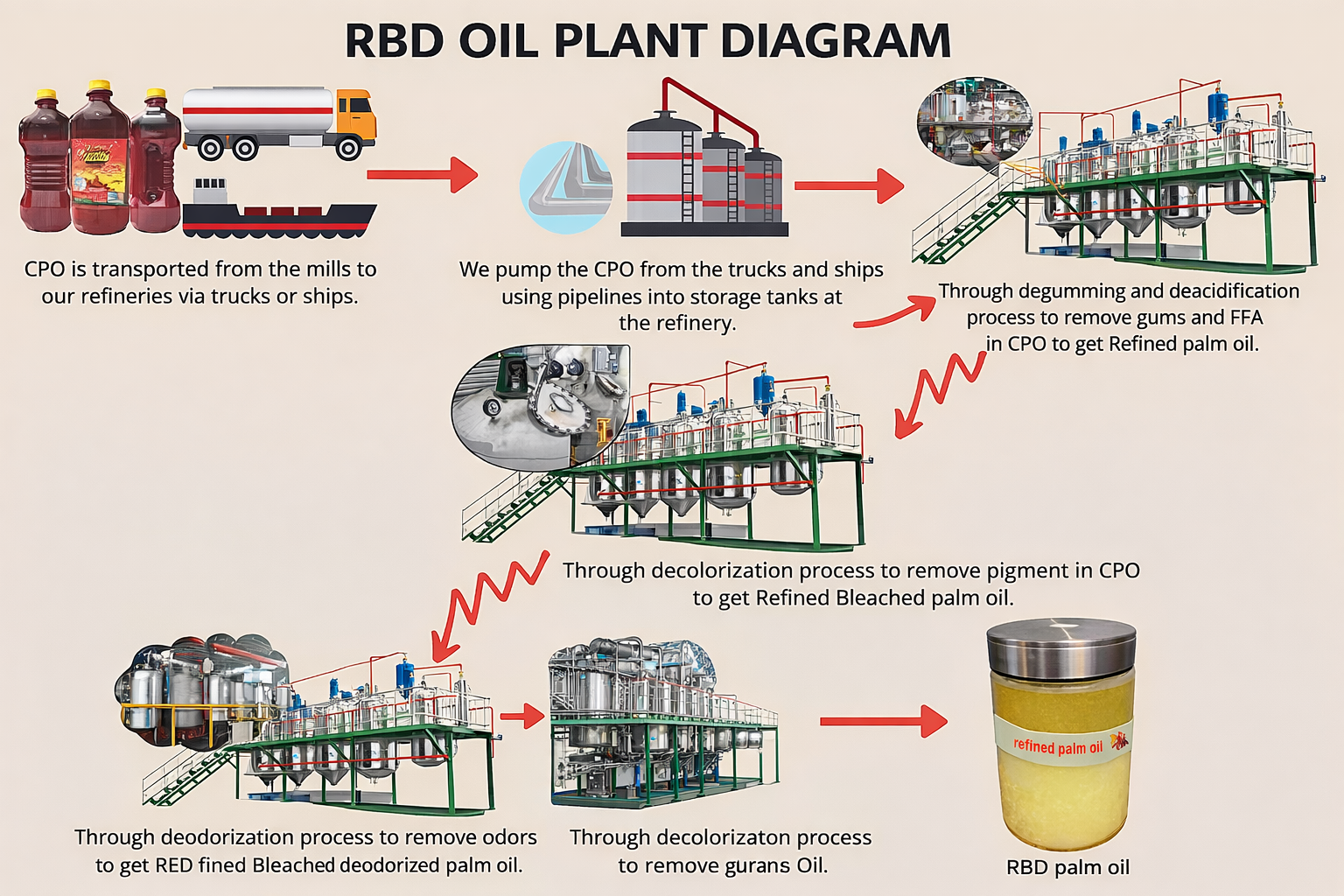
What is RBD Oil?
RBD oil stands for Refined, Bleached, and Deodorized oil.
It is edible oil that has gone through industrial refining to remove
impurities, color, smell, and free fatty acids.
Common oils sold as RBD:
· RBD Palm Oil
· RBD Sunflower Oil
· RBD Soybean Oil
· RBD Canola Oil
· RBD Groundnut Oil
RBD oils are neutral in taste, smell, and color,
making them widely used in homes, hotels, bakeries, and food industries.
· Crude oil contains free fatty
acids (FFA), gums, waxes, and dirt.
· Oil is treated with alkali
(caustic soda).
· FFAs are removed as soap stock.
· Result: cleaner, more stable oil.
· Oil still has natural pigments
(yellow/red).
· Heated oil is mixed with bleaching
earth or activated carbon.
· Pigments, metals, and oxidation
products are absorbed.
· Oil is filtered.
· Oil still has odor and taste
compounds.
· High-temperature steam is passed
under vacuum.
· Volatile substances causing smell and
taste are removed.
· Clear, light-colored oil
· Neutral taste & aroma
· Long shelf life
· High heat stability
|
Feature |
RBD
Oil |
Cold-Pressed
Oil |
|
Processing |
Heavy (chemical +
heat) |
Minimal |
|
Aroma |
Neutral |
Natural |
|
Nutrients |
Lower |
Higher |
|
Shelf life |
Long |
Short |
|
Cost |
Lower |
Higher |
|
Best for |
Hotels, frying,
bulk use |
Health-conscious
cooking |
· Hotels & restaurants
· Bakeries & snacks
· Packaged foods
· Home cooking (urban households)
· Frying & deep-frying
RBD oil is clean, neutral, long-lasting, and affordable —
perfect for large-scale cooking — but it sacrifices natural nutrients and aroma.
If you want, I can also:
· Compare RBD vs cold-pressed
vs filtered oils
· Explain RBD palm oil
specifically
· Help you decide which oil is
best for Mr Kissan brand